Friday, February 23, 2007

Returning Meaning to the Collections

This week I’ll be a little long-winded, but I figure it’s about time to really sum up what I am trying to do here, and why it’s a little more complicated, and much more important, than some people think. My title suggests a goal, but the first step to achieving it is not necessarily calling in Antiques Road Show or writing a history of Gananoque (although both are good ideas). The first step is getting down the basics of a solid, accessible, usable catalogue and a functional storage system.

I am sure that at one point there was someone in charge of the Gananoque Museum who when asked where some item was, knew immediately where to look, what its historical significance was, who donated it, and could bore anyone to tears remarking on its relationship to other objects in the collection. Once people like that move on or pass away, so much goes with them. The problems with the Gananoque Museum may stem from that quirk of local history. After so many years, the collections have been left in a state which does not allow them to tell their own story. Going through the collections over the past six months has been as much of an archaeological dig into the history of the museum itself and the people that ran it, as it was into the history of the artefacts it houses.

At one point, say 15 – 20 years ago, all three floors were filled with items on display. While most museums have 80-90% of their collections tucked safely away and rotate them out for visitors to see, the Gananoque Museum basically showed off everything at once. I don’t recall too many specifics of going through the museum as a child, but it must have been a bewildering hodgepodge of disjointed artefacts and stories. When I worked at the museum during its last open season in 2000 there was only one floor left open, but I remember that there was no stream or storyline to the exhibits. Rather, it was merely a venue for fine china and war trophies – the front parlours for the fancy dresses and furniture, the back rooms for the military items.

Since I began working through the collections it has become evident that perhaps the main problem with creating exhibits in the past was that the museum staff simply didn’t know what they had. Storage and cataloguing are vital to maintaining a museum. A museum must be able to live on and function after its creators or guardians have moved or passed away, otherwise the entire purpose of the museum is defeated. It simply isn’t enough to take an inventory, put it in a binder somewhere and say that it is done.

You can see here the card catalogue used by the museum from 1978 to 1995. (Now, before I go on I am not knocking card catalogues. I have used some, like at the Litchfield Historical Society, which were very well put together and cross-referenced. Small museums must do the best they can with what they have.) While sections of the Gananoque Museum’s catalogue were done well, after 1978 it was only added to in trickles, while there was a torrent of artefacts actually coming in. What stories people shared of this or that object as they donated their possessions for the greater good of the community were lost because they simply weren’t written down by staff, or if they were, the files were not kept.

The museum works on a basic trinomial numbering system. A set of three numbers is supposed to be attached somehow to every artefact. For example: 964.1.1 (ie. donated in 1964, from donor 1, item 1). Prior to 1978 it appears there was a different numbering system altogether, and the artefacts were then renumbered in the 1970s. This explains why some artefacts have a mysterious mark on them such as A-12, and then have a date of June 1978 on the card. But, while the card catalogue was added to until 1995, it is actually short nearly 2 000 artefacts that were never accessioned until 1999. These artefacts are recorded in a handwritten binder which uses a completely different method of classification. Then there are the mistakes: items with two numbers, items whose numbers have worn off, items such as dustpans and sheets which were accessioned, items that were just loaned but were accessioned into the permanent collections, items that were destroyed and thrown out during several moves, lost cards or even lost drawers of cards. (Remember you can click on pictures for a larger image).

Our digital age provides us with the means to correct or at least prevent anymore messy problems like these if proper safeguards are put in place. I am currently working on tracking down the best cataloguing system that will allow key-word searches and keep everything straight. No matter how good a system we have for recording WHAT we have, it is just as important to record WHERE we keep it. The most basic and fundamental need of a museum is to keep these things straight. Without that, we just have a pile of old stuff, and that’s exactly what happened to the Gananoque Museum Collections. For example, we knew that there was supposed to be a set of spurs from Dr. Hale in there somewhere, but it took 2 months to find them, and they were found by accident. The other artefacts pertaining to Dr. Hale, his moustache comb, his medals etc. are scattered all over. We had no idea what the full collection of Hale artefacts looked like, and to try and discern this from a card catalogue was a horribly inefficient task as many of the cards were missing.

This conundrum is easily remedied as soon as we apply a computer. Since January, I and the trusty band of volunteers have been going through the collections room by room, and recording the numbers and photographing each item we find. After recording the catalogue numbers and renaming the file names of each picture with the number, all of a sudden, a whole whack of 990.36.1a, b, c, q etc. from all around the museum line up neatly, and we can see all the artefacts pertaining to Dr. Hale. The next step of keeping these relations straight on a database is easy. Of course now we have to store everything in an orderly fashion so, when this is all done, someone can look up “spurs” on the computer database, go to the proper shelf, and find them there. In addition, and perhaps just as vital, the computer will show (ideally) that these are the spurs of Dr. Hale, tell us why he was important (see Lest We Forget Post from November) and point out the locations and significance of the rest of his kit and equipment. So, simple enough and we just need to do this 4500 more times.


What has also become clear to me is the value different administrations placed on artefacts of various sorts. When I worked at the Gananoque Museum in the summer of 2000,(I was a teenager then), one of the main problems I had, aside from not having washrooms for the public, was the fact that everyone who entered immediately thought they had come into an antique store. Hutches and Whatnots, Victrola’s and China greeted the visitors to the Thousand Islands. Slowly over the years, the range and variety of the museum collection seems to have been neglected for the sake of these artefacts which really do not tell much of a story, and what they do tell is only of a tiny minority of the people of Gananoque. What made the wealthy owners of these objects so wealthy were industries and the men and women who laboured in the factories.


Over the past couple of weeks, myself, John, Eileen, Marica, Kathy and Aidan, have uncovered a vast array of objects from Gananoque’s industrial past. While the shelves full of Victorian china and the other fancy possessions of the wealthy elite were proudly displayed, the remnants of the industries which made Gananoque were stored away in the tiny space in the attic. The often small, rusty bits of cast-iron embossed with a logo or patent date, (wrenches, machine parts, stamps, riveters etc.) are not much to look at, but tell us reams more than any fancy teacup or porcelain doll could ever say about the growth of this town. These were all carefully catalogued and accessioned at one point, their uses clearly marked on little tags which hang from them. Really, the section of rusty old tools was the only area that had any semblance of order when I found it, simply because it had never been touched. Fancy top hats were strewn everywhere, but the spoke shavers and cobbler’s moulds sat quietly undisturbed as they had for 20 years. Of course, a rusted clamp or seized-up threading machine needs to be interpreted, just as any artefact does; they need to be understood in relation to a bigger picture and to other objects. For example, I wrote the posting on the Gananoque Citizens Bands a few weeks back, and just the other day, found the very trophies they won in the 1930s, tucked away with a bunch of high school trophies from the 70s. Or these files, logo stamp, and shovels in various stages of production from the Jones Shovel Company, stored separately for good reason, but there is nothing to link them unless one takes the time (and it’s a lot of time) to carefully look through thousands of cards or thousands of objects. In other words these items may as well have been lost. In so many ways, these artefacts are valuable as a group of items that tell a story - they have much less value separated.

Of course we can’t actually store these items together, that wouldn’t work, but a computerized system would at least remind us that these associated objects exist and where we can find them. Again, this is something that could be easily accomplished by someone who knows these items and their significance - but we don’t have someone like that, and neither should we rely solely on someone like that if we did. This fact only makes it clearer that the whole point of a museum is not just to preserve artefacts - it is to preserve memory, to preserve knowledge and meaning after people are gone. Sadly, this is something that was not done properly. I think part of what compelled me to take on this task, to try and fix things before they got worse, is summed up in what a professor of mine, Dr. Alan MacEachern of the University of Western Ontario, once told us (albeit in a slightly different context). History, he wrote, “…holds a promise — and a threat — to people of today, that they won’t be forgotten either.” I think it’s an idea people should remember. [1]


[1]Quoted from Jan. 31, 2006 – “Old East London Blog” http://digitalhistory.uwo.ca/ma0506/index.php/2006/01/

Friday, February 16, 2007

Things are Coming Together!


Remember this?


We’ve come a long way since a few months ago when things were scattered all over and one could barely move in the “storage areas” of the former Gananoque Museum. Over the past two weeks we have pushed way ahead, and now the results of a finished project, although still far off, are becoming more and more easy to picture.

What has been most encouraging over the last little while is the strong support the project has received from a number of sources. Most importantly, the Town Council of Gananoque has pledged the needed funds to ensure that this valuable project can be completed. This will not only benefit residents and visitors now, but for generations to come. It is a real privilege to live in a town where those in power really appreciate and understand why our history is important and worth preserving. I cannot thank town staff enough for all their help in everything from providing workspace, to clearing away debris and of course, in financing the project, including the shelving (2/3 built) you see here.

I also had the pleasure last week to sit in on the first meeting of the Gananoque Heritage Committee. The committee is made up of some very enthusiastic and concerned citizens, who have brought a wide range of experience and expertise to the table. Many thanks to Councillor Frank O’Hearn and Town Planning Coordinator Brenda Guy for facilitating the meeting. I look forward to seeing all the great initiatives to preserve the historic structures and landmarks of our community.

Another important thank you I must send out is to Queen’s University Archives. Some time ago I was approached by archivist Paul Banfield, and happily loaned him our collection of Joel Stone papers and account books to be inspected and finally copied, so as to make these previously unknown 18th and early 19th century documents available. Last week, Heather, Deidre, and Jeremy, archivists at Queen’s, came to have a look at our collections here and provided the project, at long last, with a computer that will finally allow us to get a working, modern computerized catalogue system up and running. I cannot thank Queen’s Archives enough for the equipment, nor Heather, Deirdre and Jeremy for all their kind words and support. They are welcome here anytime!


Finally, the Arthur Child Heritage Museum was abuzz this week as we hosted the Ontario Senior Winter Games. The museum’s main gallery was transformed twice, first as the registration centre for the games, and then for an evening of dining and nostalgic entertainment, “Puttin’ on the Ritz.” The event was a huge success. Director Linda Mainse would like to thank Linda Davis, of Metro-Management Solutions, for organizing the event, and the staff of the Arthur Child Heritage Museum for all their assistance. MC Doug Revell, Paul Harding, Michelle Kazaboski and Dreams in Motion provided wonderful entertainment for the evening. And finally, many thanks to the Gananoque Secondary School’s Hospitality Students and the Canadian Academy of Travel and Tourism for all their hard work and excellent service.

Friday, January 26, 2007

A Mirror with a Memory

Before I jump into this week’s subject, I thought I would share a scene, especially with readers not from around the Gananoque area. We’ve finally gotten our cold snap, and while walking into work this morning I noticed that the waterfalls had become very quiet. The reason, as you can see from these pictures, is that they are frozen. This dam continues to control the flow of the Gananoque River, and regulated the water that powered the many industries that lined the riverbanks in the past. Today, the waterpower that built Gananoque is still important, as it generates electricity for the town.


My title is taken out of the Canadian Conservation Institute’s exhaustive “Notes,” and refers to the first photographs ever produced: the ghostly Daguerreotypes. The Daguerreotype was invented in France in 1839 by L.J.M Daguerre, who agreed not to patent the invention in exchange for a pension from the French Government, allowing the technology to easily spread in the following years. These early photographs were made with “silver amalgam” a mix of silver and mercury on a copper plate. The result is a very reflective, mirrored surface with a negative image on it. Much like a hockey card hologram, you have to turn the daguerreotype and have the light hit it at an angle in order to see the actual image. When revealed the image is exceptionally clear, if somewhat spooky. They really do seem like “mirrors with a memory.” The daguerreotype you see here, to the right, is only visible because it is reflecting the outside of a black binder. The left picture is actually reflecting the knit of my sweater, and the half-dozen previous shots revealed only a reflection of my camera in the frame.

Just like today, with our own emerging competition between Blue Ray and HDDVD, different forms of similar technology competed for the mid-nineteenth century consumer market. Daguerreotypes were considered too expensive and too time consuming, and fell out of use by the American Civil War in the 1860s. Yet, their ethereal quality has ensured their continued use to this day, as some artists still produce them on a small scale. Paper photographs obviously won out in the end, but for a time, two other varieties competed: the tintype and the ambrotype. [1]


We don’t have any examples of the ambrotype, which was a negative image made on a sheet of glass with a dark backing of paint or cloth to give it the appearance of a positive. The ambrotype was invented in the 1850s, but by the late 1860s or early 70s they had more or less gone out of fashion.


The tintype is perhaps the most widely known and was the most common of these early forms of photography. “Tintype” is actually a misnomer, since the pictures are actually made on very thin pieces of iron, and are therefore sometimes more properly referred to as “ferrotypes.” These tintypes or ferrotypes were likely in an album or a fancy frame at some point but were taken out long ago. They are all somewhat irregularly shaped, with few straight edges. They are tiny, only a few inches square, yet they are very detailed. Unfortunately, as with so much in the collection, the catalogue cannot identify the people in the pictures. Clothing and the technology can give us some inexact clue to the dates, but for the most part the identities of these people are lost to time. They are important, however, as the process for making tintypes and daguerreotypes resulted in only one copy being possible. There can be no other original copies of these particular early photographs.


Finally, there is a little mystery with this one. It appears to be made of copper, it is certainly a negative and is affixed to a small wooden block. I have no idea what kind of early photograph it is. If anyone has an idea, please let me know. [Jeremy from Queen's University Archives has since informed me that this would have been used in printing, making copies of this image. That fact only increases the mystery of who this woman is!]


Volunteers

At long last, we have begun moving our volunteers over to the main collection area and have started the long process of photographing the entire collection. Things are moving very quickly with so many helpful and enthusiastic people hard at work. We have also begun thinking about setting up an exhibit for the summer. Our subject will be: Gananoque Industries, Labour and Lifestyle, 1860-1890. Many thanks to Pam and Lisa for getting in on the early stages of research.

I am currently setting up small exhibit on winter sports for the upcoming Senior Winter Games being held in Gananoque, and thought I would include a couple of the pictures found by volunteers John McDonald and Eileen Truesdell. So, for this week’s splash o’ nostalgia here is the all-star line up of the 1930, trophy-winning, Gananoque High School Hockey Team. Luckily, the names are listed and we have, in the back row: Ray Hawke, Arnold Bates, Harold White, Gerard Gardener, Henry Littlejohn, Oliver Wing and Archie Sequin. Front Row: Bill Valentine, Bernard O’Hearn, Bernard Shine, Merrill “Smiley” Cummings.

Next week I’ll hopefully be able to show a little on the storage plan for the artefacts and a show off some of the many thousands of artefacts in the Gananoque Museum Collections.

[1]Canadian Conservation Institute, Notes. 16/1 "Care of Encased Photographic Images" also see http://memory.loc.gov/ammem/daghtml/daghome.html for an excellent link to more information on Daguerreotypes, Tintypes and Ambrotypes.

Friday, January 12, 2007

The Gananoque Citizens' Band

Just after Christmas in 1920, Gananoque ratepayers received a letter from the Gananoque Citizens’ Band. It implored the town’s people to support a special bylaw that would see the band receive a small stipend for the appointment of a permanent band leader and to pay for instrument repairs. The letter argued that this would ensure the continued existence of the venerable institution. It seems the band had fallen on hard times as radio and movie theatres had cut into their market. The letter, signed by band manager W.J. Kelly, asked:

“Does the band not help to increase tourist traffic annually? Does it not give 52 weeks free advertising to your town? Does it not brighten your recreation hours at the park in summer at the open airs, or soothe you when you enjoy the placid bosom of the St. Lawrence by moonlight? When you bury your illustrious dead these funeral are ours. When you do honour to the living, these occasions are also ours” [1]. (Left is a picture of the Gananoque Citizens’ Band Music Chest in the Museum Collections)

I wasn’t able to find whether or not the bylaw passed, but the Gananoque Citizens Band did continue to play for over 50 years after this letter was sent. In spite of the dramatic appeal of 1920, the Gananoque Band had been thriving during the first decades of the 20th Century.

Originally, the militia organized the first band in Gananoque in 1854 and they practiced in Auchinvole’s Tannery, a large red brick factory that once stood, aptly, on Tanner St. A military officer, Captain Murdock, was the instructor and a local man, J.B. McMurchy, was the leader. Two years later, the Gananoque Carriage Works formed the Silver Cornet Band which was manned with the remaining members of the militia band and eventually evolved into the Gananoque Citizens’ Band. Like so much else in Gananoque, industry was the real starting point. In fact, industrialization was the root of many such local bands throughout North America, just like the English band movement a few decades earlier. The brass band was a symbol of pride and prosperity, and formed one of the only outlets for the arts in a rural or industrial community [2].

This photograph, taken in 1860, shows the Gananoque Brass Band. According to the names scribbled on the back Captain Murdock and J.B. McMurchy are shown, but it’s unclear which ones they are. The man in the white striped pants is likely one of them. The military influence in the band is clearly seen in the kepis and uniforms.

In the decades that followed, the band became a central part of the community. With the onset of the “Golden Age” of tourism in the Thousand Islands, music was in demand. Entertaining the wealthy captains of industry and Victorian elites who retreated to their castles and hotels in the islands was certainly lucrative. It was during that time that a young composer and baritone player named William E. Rees moved to Gananoque from Cincinnati, Ohio and took over as band leader. It is possible that Rees is in this photograph, taken in Oshawa in 1900, standing fourth from the right. If you look very closely you can make out “LEADER” on his cap. According to one source, “Bill Rees was a distinctive character, a rugged individualist who called a spade a spade, and his superb musicianship was unquestioned.” Working as general superintendent and engineer with Parmenter & Bullock manufacturing and then Ontario Steel Products, both in Gananoque, Rees also served as orchestra leader for the upscale Thousand Islands Club on Wellesley Island and the famed Frontenac Hotel on Round Island. Rees’ most lasting contribution to Gananoque was in designing the bandstand which stands today in the town park and continues to be used [3].

Interesting enough, William Rees formed his own band, The Rees Orchestra, and the two bands amalgamated sometime in the first decade of the 20th Century. Ever conscious of changing times, the new Citizens Band and Rees Orchestra attempted to branch out into new forms of entertainment. In 1908, they leased the Grand Opera House where they opened a “Five Cent Theatre.” Great care was taken to advertise the fact that “our machine in the first place is strict FIRE PROOF and will thereby insure our patrons’ absolute safety which they could not expect in almost any 5¢ theatre in Canada…” Furthermore, “Murder scenes, Prize Fights and all objectionable pictures will positively not be shown…” [4]

I haven’t been able to determine how long the band/theatre operation lasted, but by 1920, it had obviously closed up.

The band continued on until the 1970s under a number of different directors. A junior band was also formed to train the next generations of band members. This small town band went on to compete and win in several competitions including the Perth Courier Cup, 1931, 1932, The Canadian National Exhibition in 1932, and the Dominion Championship in 1933, and certainly helped lift spirits around Gananoque during the Great Depression.

All things must come to an end, of course, and the Gananoque Citizens’ Band is no longer with us. Their training house became a daycare, and bands were brought in from elsewhere to play in the town park. It was common across North America for community bands to fold up in the 1970s. Economic recession and changing interests were the main culprits. Brass instruments fell out of style with young people, and new forms of entertainment – television, records, rock music and cheap car rides to the city – spelled the end for this, and many other, small town citizens’ bands [5].


Volunteers

Many thanks to our volunteers, Eileen, John, Marcia, Kathy and Aidan for finishing off some big chores this week. We have nearly all the photographs present in the Gananoque Museum Collections inventoried and we’ll now set about getting them copied. The extensive coin collection has also been documented by Aidan and Kathy who have made some more interesting finds. In the coming weeks, we’ll begin to show off some of the interesting items we find as we take stock of the large archival holdings and a few other interesting odds and ends.

[1] General letter to Gananoque Ratepayers from W.J.Kelly, Gananoque Citizens’ Band, Dec. 28, 1920
[2] Pages from unnamed published book found in non-accessioned dossier, Gananoque Museum Collections. For a general discussion on the roots of the band movement see: Michael J. Lomas, “Secular Civilian Amateur Wind Bands in Southern England in the Late Eighteenth and Early Nineteenth Centuries,” The Galpin Society Journal, Vol.45, (Mar., 1992) pp.78-98
[3] Same unmarked dossier as above
[4] Open letter from The Citizens’ Band, April 24, 1908
[5] See: Jay Zorn, “The Changing Role of Instrumental Music” Music Educators Journal, Vol. 76, No. 3, (Nov., 1989), pp.21-24

Wednesday, January 03, 2007

The Changing Meaning of Symbols

One of the many problems with small town museums is that the collections are often so similar to others that they become redundant, with nothing to separate one museum from another for visitors. Every museum, of course, has something unique, but every North American museum seems to have a spinning wheel, a butter churn, wool cards and a plethora of military uniforms. Narrowing the local museum’s mandate has become the norm since the early days of every community having a museum that collected everything. While I have written about my amazement at finding sawfish snouts and 500 year old English oak, there are some interesting things that can emerge from the hodgepodge. Disparate and dissociated artefacts can begin to have some relationship between them, and Gananoque's museum collection can quietly speak about larger things.

Take for example this quilt and this serving dish. Many North Americans and Europeans would be shocked to find a swastika quilt under their tree at Christmas, and the serving dish, if manufactured today, would likely be used as proof the makers were some sort of potter-neo-Nazis. In fact these scattered and unrelated objects tell us a great deal about the changing meaning of symbols in the west. Before the Nazis came to power and killed countless millions under the banner of the swastika, it was a sign of good luck. To this day billions of people in Eastern cultures continue to revere it. Although we in the west associate violence and evil with the swastika, it is also one the most revered icons of the Jain religion, one built on ultra-pacifism and respect for life. It is one of the oldest symbols of the world, one found from India to England, Africa to Japan; a common religious or folkloric icon at home in hundreds of cultures and thousands of places, often used to ward off evil or bring good fortune. The savage events of the 20th century changed that benign symbol into one immediately identifiable with the worst of human nature, at least to westerners. So these once treasured belongings now appear to us as oddities from, perhaps, a more innocent past.

In other news, work has begun again after the holiday break. To date we have surpassed 1000 artefacts inventoried, or getting close to 25% complete. Queen’s University Archives has taken an interest, and has kindly offered to take in our collection of Joel Stone papers and account books on loan to be copied and professionally treated. My thanks to Paul Banfield and the staff of the Archives for doing such a great service for our town and museum collection.

Finally, having received a number of inquiries and comments on the Gananoque Citizen’s Band, next week I will discuss that proud and venerable institution that entertained Gananoqueans for over a hundred years. A point of nostalgia for many, the Citizens Band was part of a tight-knit and proud community. It was more than just a band; it was a major part of any town event and added a richness to small town life. It died out with the advent of Television and the changing tastes in leisure. People were drawn away from the town park bandstand and regular communal entertainment into the solitary comfort of their living rooms.

For Further reading on the changing meaning of the swastika see: W. G. V. Balchin "The Swastika" Folklore, Vol. 55, No. 4. (Dec., 1944), pp. 167-168

Friday, December 15, 2006

Streetscapes and Coins

With the volunteers busily working, the project continues to make some great headway. Last week town staff arranged the removal of some of the large, antique, display cases to off-site storage. Now the old factory floor of the Jones Shovel Factory has space to bring in shelving and will hopefully provide a lasting storage space for Gananoque’s historical collections. There are many challenges to the space: the ceiling is a bit high and it will be a struggle to keep the humidity under control, but it is the best option we have found so far. The large windows have been covered so we have successfully resolved the light issue.

We had five volunteers working in our space at the former Textron plant this past week. To date we have inventoried some 720 artefacts (approximately 17%), and have removed hundreds of photographs from damaging frames and self-adhesive albums. Some damage has been quite severe, but we have reached other photos just in time. When this phase of the project is complete we will have the whole collection scanned and it will be available for the town’s people. Luckily, we have Eileen Truesdell and John McDonald working on the photos, and their knowledge of the town has provided some great information for what would have remained anonymous pictures.

Aidan Baker and his mother Cathy are among our most enthusiastic volunteers and have been working with intern Erin Findlay on cleaning and cataloguing a collection of 200 or more coins from all periods and places. Much of the time has been spent on the delicate and careful removal of tape and old rubber foam used in former displays. The adhesives have almost permanently grafted (or cross-linked as we say) to the metal and removing it is a time consuming and frustrating chore. In ideal conditions, chemicals and a fume hood would speed things along, but our workers do their best with Q-Tips and distilled water. Aidan has found some very interesting coins in his work. This Upper Canadian coin from 1816 (on the left) commemorates Brock’s death at the Battle of Queenston Heights in 1812. You can see how the tape and glue has obscured and damaged the face. The collection also includes a number of coins relating specifically to Gananoque such as a silver dollar depicting the Gananoque Town Hall and the curious wooden nickel which was a favourite souvenir in Gananoque in the mid-Twentieth Century.

While working with volunteer David Wells at the Chamber of Commerce we came across our first real experience with some active mould. As you can see, the artwork, (a presentation to Charles S. McDonald for all his service to the community), is nearly destroyed and the mould is still working at eating away the rest of the paper. We have isolated this artefact so it does not contaminate others until we determine how best to treat it.

To end off this week, I have included four pictures of Gananoque landscapes. The first is a postcard from the 1960s and shows how different the streetscape looked. The clock tower is where the Toronto Dominion Bank now sits and across the street the Bank of Montreal. I have tossed in a present image of the street for comparison. I am sure many will agree that the push for a modern look doesn’t always have the best results.

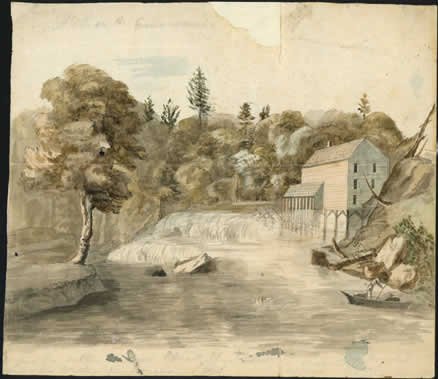
This drawing dated May 28th, 1870 is a “Wilmott Print” and depicts the falls on the Gananoque River that powered the various mills. You can see the logs collecting at the base of the rapids below the bridge. Finally, the photograph on the right, as you can see in the writing, is of the same mills depicted in the print. The picture is from the 1880s and the caption tells us that the man driving the horse is Frank Latimer, a family name still very much alive in Gananoque.

As we move through the collection it is becoming more and more evident just how important and representative the artefacts and photographs are to the history of Gananoque. The educational potential for young and old alike is unlimited. I would like to thank the Town staff for all their help this past couple of weeks in removing heaps of rubbish and the display cases. Many thanks also the Eileen, John, Cathy, Aidan, David and Kathy as well as intern Erin for all their hard work.

Friday, December 01, 2006

Discoveries of Early "Cadanoghqua"

This morning, while searching about for that great artefact to display online, I stumbled across an old file case marked “Deeds, Mortgages and Legal Documents.” I popped it open to find yet another trove of forgotten items – land grants from every era of the Nineteenth Century, files from factories and receipts to and from local businesses. The most important items, bar none, were two tattered account books. The first dated 1818 belonged to a merchant in Gananoque – perhaps Ephraim Webster whose shop appears on the military sketch in 1815. The other immediately caught my eye, as the hand writing was very familiar. There is no doubt that this is the town founder, Joel Stone’s account book from 1795-1796. I have done a considerable amount of work on Stone and his times, and this find was astonishing to me. To my knowledge this piece is more or less unknown, and contains a vast amount of information on the day to day workings of a frontier outpost. The settlement, “Cadanoghqua” as it is spelled in the account book, had barely begun, and was little more than a cluster of shacks and two mills. Lady Elizabeth Simcoe, the wife of Upper Canada’s first Lt. Gov., John Graves Simcoe, stopped at the settlement the year before and recorded her impressions.

“A very wet morning after a night of incessant rain; the Canadians would not stir, so I waited to breakfast. Mr. Stone, who is building a mill opposite Fairfield’s came, and was extremely civil; brought butter and milk. About nine the rain ceased. I walked to look at the mill and embarked. Gave a dollar to the people. Mr. McGill said Stone was too much of a gentleman to offer anything to. The mill he is building is to have 15 saws. He says there is a portage of only half a mile from the Gananoqui to the Rideau.”

Curiously she also reported the same day: “Our Canadians are old and do not sing; however, I made them sing “Trois Filles d’un Prince,” tho [sic] indifferently.” [1]
Of course here we also see Lady Simcoe’s painting of the settlement only 4 years before Stone began keeping his records in this account book, (Image Courtesy of Archives of Ontario). The settlement was transforming rapidly as Stone and his many workmen cleared the wilderness and built their new lives.
The account book contains information on what he was buying and selling in the local area and the tiny number of names listed is a clear indication of how small the population was. This book is not only a reflection of early Upper Canadian commerce, but also how New England merchants did business. It is sometimes easy to forget that Stone spoke with a New England accent and carried on in the ways of a “Yankee” merchant. Stone’s new little Kingdom was in many ways a new New England, and it would be decades before English-speaking people would refer to themselves as “Canadians.” The entries range from his own records of paying for passage to Kingston and paying to feed his men en route (the men are never named), to agreements to cut and deliver planks and boards, to buying “Dear skins” from Silas Judson and other woodsmen. It also lists the many luxuries that Stone imported into the area – linens, buttons, silk handkerchiefs, and calico.

What is wonderful about the account book is that it not only tells us who was living in the settlement and who was buying what, but it also has other very interesting entries. For example, on Weds, 2nd March 1796 “Benjamin Butterfield began work______at the rate of 8 dollars per month to take his pay from the store.” There was little actual cash on the frontier. He also recorded the weather on the back of the book: “…this is the 20th day of January 1796 and is the first time I have seen the Cadanoghqua river shut with Ice this Season so as to prevent Boats passing up to the Mills.” Fascinating stuff, and there will be more to come as I use my spare time to transcribe this and other fantastic finds.

Volunteers

This week we also began our volunteer program, and it is off to a great start. Our present task is removing hundreds of old pictures from their decaying and damaging frames and encapsulating them in acid-free plastic. In addition, we are filing the pictures and taking a detailed inventory. It is a huge task, and with so much else going on, with the help of our dedicated volunteers it can finally be accomplished. In the New Year we will begin to scan the pictures and make them available for the community. My sincere thanks to John, Eileen, and Dianne who participated this week, and the many others who have offered their time. There is so much to do that all offers are very much appreciated.

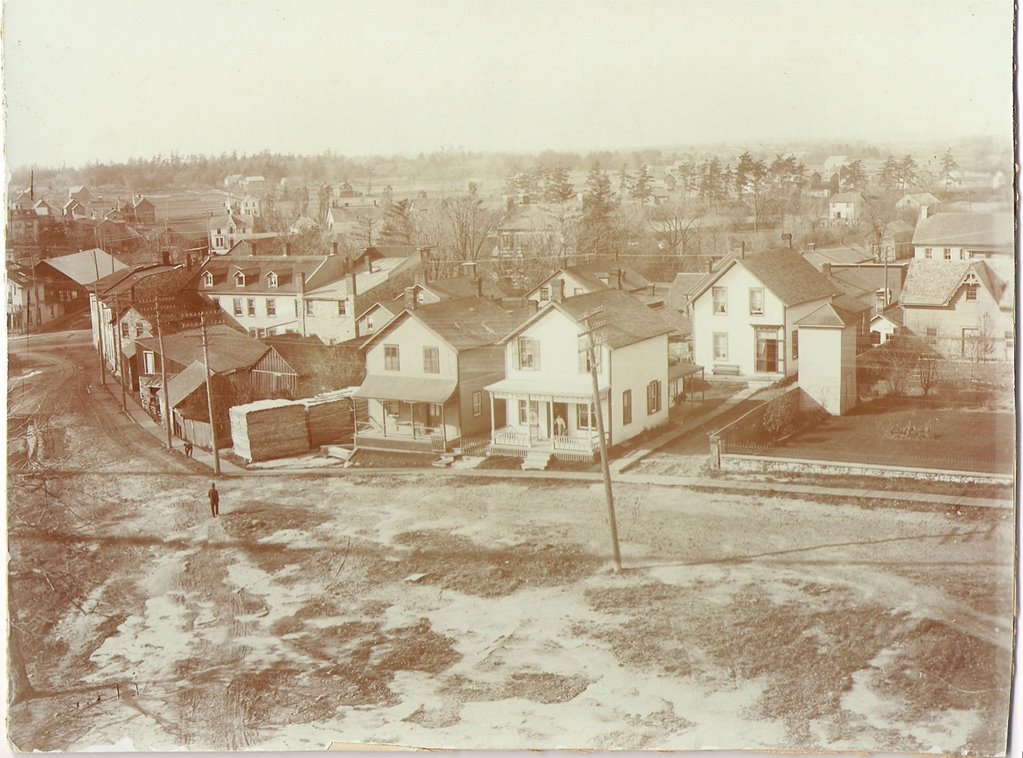
These pictures are just two examples of the photos the volunteers are working with. The first on the left was probably taken from the old water tower looking down towards King Street. In the background you can see the McDonald House (now Town Hall) and the Victoria Hotel at the far left, indicating the picture is probably from the opening years of the 20th century prior to the Shovel Company taking over the hotel. The telephone polls are interesting and I am sure could provide a more exact date for the picture. The second picture on the left shows the Gananoque waterfront long before it was a tourist destination. Where the Arthur Child Heritage Museum now stands was a Train Station and the Gananoque Inn, across the mouth of the river, was a Carriage Factory. Yet, the geography is immediately recognizable to residents and visitors.


Thanks again to Erin Findlay of Algonquin College and Kathy Karkut and all the Volunteers for their valuable assistance this week. Without their help the project would be nowhere near where it is today.
-Tim