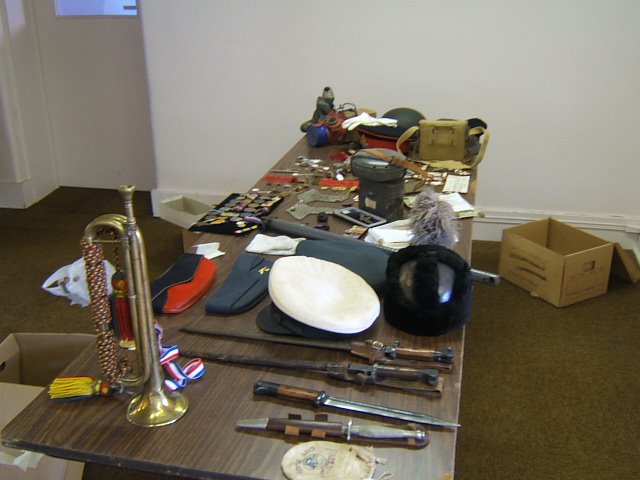
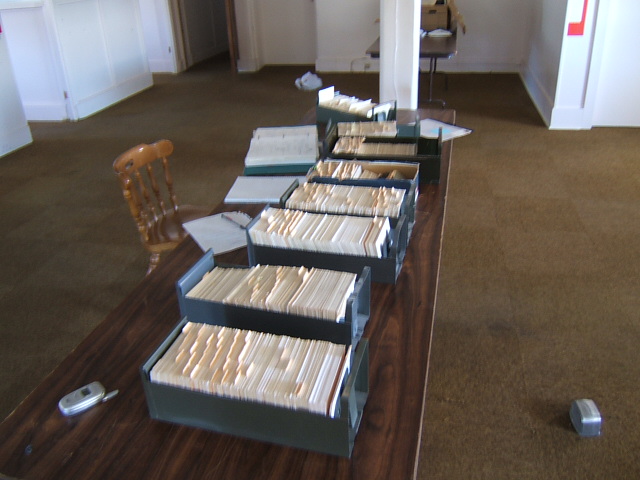
Things are beginning to move at a much faster pace around the Gananoque Collections. This week the project welcomed Erin Findlay from Algonquin College’s Museum Studies programme. She has brought a great deal of knowledge, ideas and enthusiasm into the project, which is much appreciated. We’re also finally putting our many volunteers to work, managing and organizing our large collections of photographs, postcards and coins.
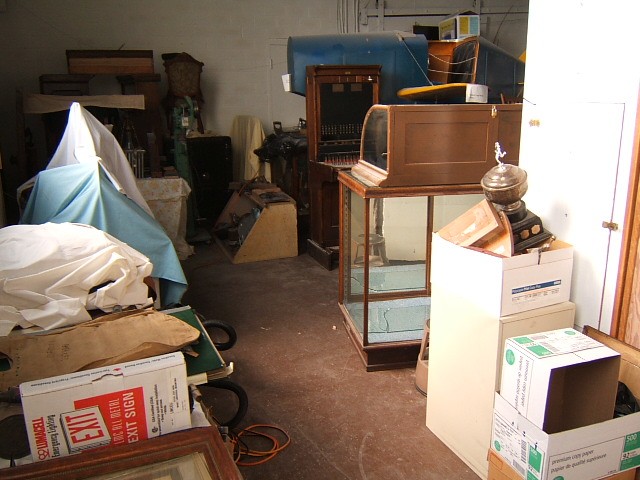
As you can see we still have a long way to go, but little by little we are moving or dismantling old display cases that are taking up space, and tossing out a decade’s worth of accumulated debris. Our head volunteer, Kathy Karkut, has been indispensable over the last little while as rooms, once cluttered and unmanageable, have been tidied up to the point where proper work can be carried out.
Last week I had the pleasure to attend and speak at a Symposium in Litchfield, Connecticut, entitled “Inventing Our Past: What, How and Why We Remember.” It was an illuminating day where speakers explored the ideas and importance of Museums, Archives and History in not only ensuring we accurately remember those who came before, but also ensuring accountability for future generations of governments. As Dr. Randall Jimmerson said, a properly run archive and trained archivist, with a mandate to seek out and preserve documents from all facets of society, can serve as the collective memory of a group or community, and can act as a check on the potential abuses and invented histories of governments.
I spoke on the invention of the Loyalist Myth, a “tradition” that little resembled the majority of refugee experiences, and I talked about how that influenced the politics of Upper Canada for a century after the Loyalist settlement. Of course, Joel Stone, the founder of Gananoque, was a Loyalist from Litchfield, so it was an interesting experience to share his story in his former home town. My thanks to Archivist Linda Hocking, Curator Julie Frey, and Executive Director Catherine Fields for their warm hospitality. While there I had the added pleasure of being lodged in the Tapping Reeve House and Law School shown here. Built in 1773-74 and opening just after the Revolution, this was America’s first law school and educated such men as Aaron Burr, John Calhoun and hundreds of other prominent Americans. The Litchfield Historical Society, (which encompasses the Museum and Archives, and Tapping Reeve house) is an outstanding institution, and one I felt very privileged to explore. I have added a link to their site on the left.
As you can see we still have a long way to go, but little by little we are moving or dismantling old display cases that are taking up space, and tossing out a decade’s worth of accumulated debris. Our head volunteer, Kathy Karkut, has been indispensable over the last little while as rooms, once cluttered and unmanageable, have been tidied up to the point where proper work can be carried out.
Last week I had the pleasure to attend and speak at a Symposium in Litchfield, Connecticut, entitled “Inventing Our Past: What, How and Why We Remember.” It was an illuminating day where speakers explored the ideas and importance of Museums, Archives and History in not only ensuring we accurately remember those who came before, but also ensuring accountability for future generations of governments. As Dr. Randall Jimmerson said, a properly run archive and trained archivist, with a mandate to seek out and preserve documents from all facets of society, can serve as the collective memory of a group or community, and can act as a check on the potential abuses and invented histories of governments.
I spoke on the invention of the Loyalist Myth, a “tradition” that little resembled the majority of refugee experiences, and I talked about how that influenced the politics of Upper Canada for a century after the Loyalist settlement. Of course, Joel Stone,
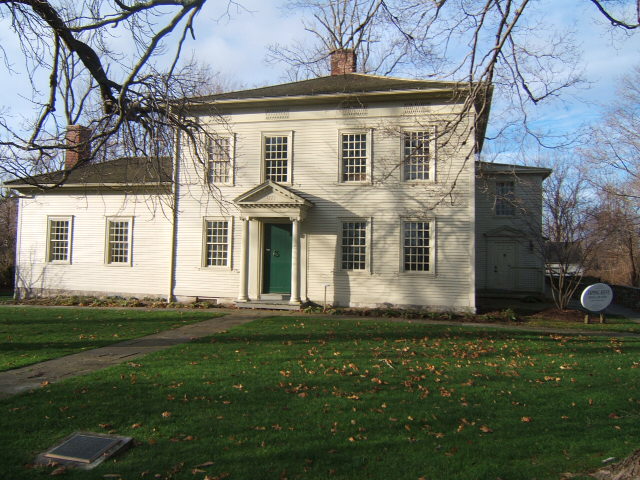 the founder of Gananoque, was a Loyalist from Litchfield, so it was an interesting experience to share his story in his former home town. My thanks to Archivist Linda Hocking, Curator Julie Frey, and Executive Director Catherine Fields for their warm hospitality. While there I had the added pleasure of being lodged in the Tapping Reeve House and Law School shown here. Built in 1773-74 and opening just after the Revolution, this was America’s first law school and educated such men as Aaron Burr, John Calhoun and hundreds of other prominent Americans. The Litchfield Historical Society, (which encompasses the Museum and Archives, and Tapping Reeve house) is an outstanding institution, and one I felt very privileged to explore. I have added a link to their site on the left.
 The symposium got me thinking of how firsts and origins are always important to any community or nation, but they are often so celebrated and revered that there are some heavy politics surrounding them. History that puts doubt on the traditional stories has been shunned in the past or deliberately covered-up as it explodes what people believe in. The reason, of course, is that our origins, to a large degree, help provide us with identity - we “own” that history and it is a part of us. To prove certain things wrong or inaccurate can sometimes be devastating. That, however, is a reality of history. As Bernard Bailyn wrote, history is a series of “delicate contrivances” where a very small amount of information can upset a whole way of thinking about a person or an event. At I talk I gave on Monday to the Leeds and Thousand Islands Historical Society, for example, it came as a surprise to some that Joel Stone did not in fact sit stranded and alone on the river bank, but already had workmen from Litchfield building his mill when he arrived at the Gananoque River. The image of the self-made frontier man is by no means destroyed, but it does cause one to question the stories we are told. Another example of this resistance to myth busting was in the 1850s, when the young historian Jedidiah Merritt presented his findings from his investigation into the Loyalist era. The Upper Canadian government at the time was horrified by the unpatriotic and often simple people of the period and asked that the grant they provided be returned. Archival memory and popular myth rarely agree. [1]
Yet, origins and firsts are important in their own right. Humans are linear creatures,
 and having a beginning places us in a timeline. The Gananoque Museum Collections contain many examples of origins and firsts. This picture is of Gananoque’s first town council in 1890 (prior to that it had been considered a village even though the population was probably large enough for it to be considered a town.) The little tag that was found with the picture lists the names as: “Back row, left to right: D.J. Reed, George Toner, J.B. McMurchy, D.J. Lloyd, E.J. Seale, John Kee, W.B. Carroll. Front Row: W.N. Rogers, Robert Taylor (Deputy Mayor), William Byers (Mayor), David Darling (Reeve), J.J. Storey." (After working with these pictures some of the faces are becomming very familiar - mainly from the mustaches...the wonderful thing about the nineteenth century are the many styles of facial hair that can often be of great assistance when identifying people).
 Stepping further back, I had the good fortune of
 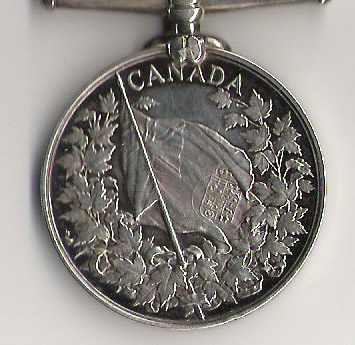 finding this medal in the bottom of a box containing dolls and doilies. Dated from 1870, this is likely the first medal inscribed with and issued by the Dominion of Canada. The Fenian Brotherhood attempted to invade Canada at numerous times and places between 1866 and 1871. Battle hardened from experiences in the American Civil War, the Irish immigrants of the Fenian Brotherhood made several violent, yet unsuccessful attempts at attacking Canada. Their plan was to somehow use the new Dominion as a bargaining chip in order to free Ireland from the British Empire. No longer a dependent colony, this was Canada’s first military conflict as a Dominion. The Fenian threat was also one of the factors which helped increase support for Confederation in 1867, as a united front would provide for better defence for the various British colonies against the Fenians or other invaders from the South.
Finally, we have a document from 1828, that more or less established
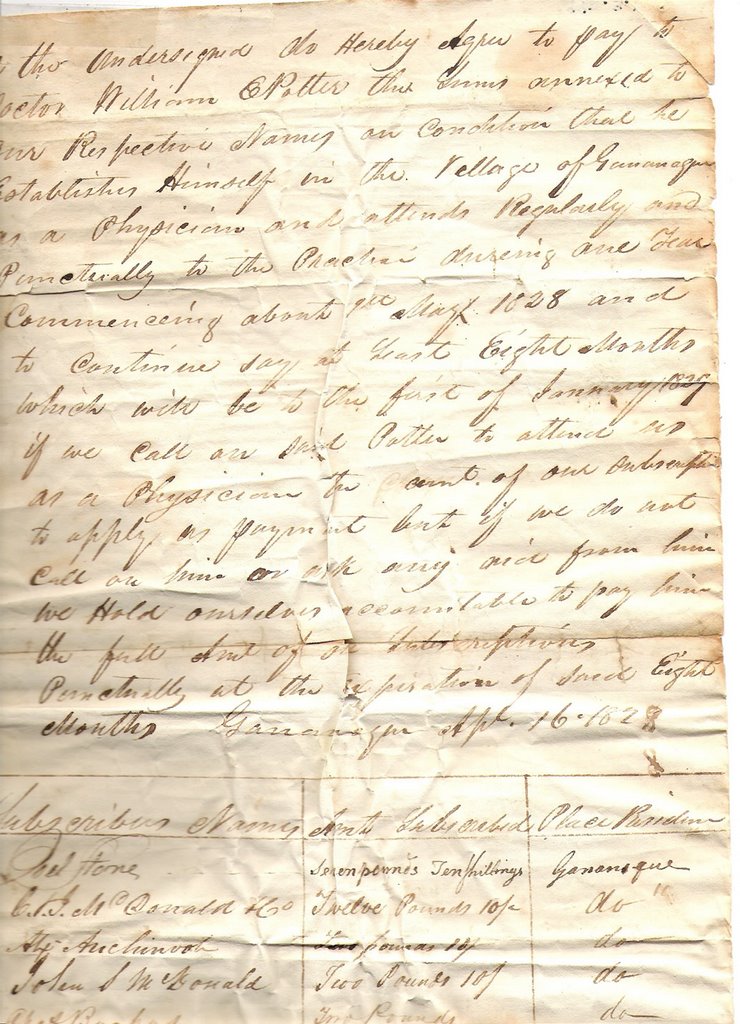 Dr. William Potter as Gananoque’s first physician. The undersigned, including the McDonald brothers, Joel Stone and other men of means, agreed to pay to have Dr. Potter in town, for at least 8 months. The term became permanent, of course, and the good doctor’s home still stands on Stone Street across from the Clock Tower. The document is in poor shape, yet is of great historical significance to Gananoque, as it marks a step in the growth from frontier outpost to town. Former museum staff made some very damaging repairs, including scotch tape and using black marker to affix the accession number. Both are extremely damaging to 200 year old paper. Although of great importance to the town, money is short to conserve and repair these items, and as always, I continue to implore the people of Gananoque to help and save their history – the history they own.
 [1] See: Norman Knowles, Inventing the Loyalists: The Ontario Loyalist Tradition and the Creation of Usable Pasts, (Toronto, University of Toronto Press, 1997)









 These are two World War II gasmasks. The adult version is quite common, but the child’s mask is much rarer. Called a “Mickey Mouse” gas mask in the old catalogue, it was meant for children 5 and under. The accompanying box has a strap which would have been worn around the child’s neck, making the mask readily at hand in case of a Nazi gas attack.